The Costa Brava: a week from Barcelona to Cadaqués
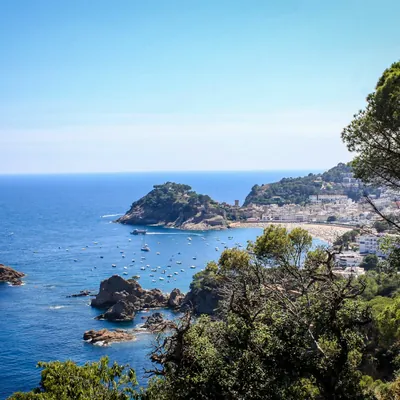
The Catalan coast north of Barcelona starts gently — the beaches and fishing ports of the Maresme — and beyond Blanes turns into the Costa Brava: rocks, pines and coves most easily reached from the water. A loop of about 120 nm from the centre of Barcelona: medieval Tossa, the prawns of Palamós and white Cadaqués by the Cap de Creus peninsula. Legs of two to four hours with one longer day to Cadaqués; it works well to sail after lunch, when the sea breeze fills in, and keep the mornings for the shore.
Day by day
Barcelona (Port Vell)
- Barcelona (Port Vell)41.376, 2.185
Barcelona airport is twenty minutes from Port Vell, and the Gothic quarter a ten-minute walk. Take over the yacht and provision in town; if there is time, spend the evening in the Gothic quarter or the Born.
Barcelona → Arenys de Mar
- Arenys de Mar41.577, 2.558
- Matarómarina41.530, 2.445
The morning is free for the city; after lunch, about three hours north-east along the Maresme coast. Arenys is a working fishing port with a fish auction, and the small restaurants beside it are the place for dinner.
Arenys → Tossa de Mar
- Tossa de Mar41.718, 2.932
- Blanesmarina41.675, 2.797
A morning at anchor off Arenys, then the leg after lunch on the garbí, the south-westerly sea breeze. Tossa is the only fortified medieval town still standing on the Catalan coast: the towered walls of the Vila Vella run right down to the beach. Night at anchor under the walls in settled weather.
Tossa → Palamós
- Palamós41.845, 3.130
A short leg north past the coves of Sant Feliu, about two hours. Palamós is famous for its prawns — the gamba de Palamós is reckoned the best in Spain — and the port has a fish auction and a fishing museum. Night in the marina.
Palamós → Cadaqués
- Medes Islands42.047, 3.222
- Cadaqués42.289, 3.277
- L'Estartitmarina42.053, 3.203
- Rosesmarina42.256, 3.179
The longest day: north past the Medes islands and across the Gulf of Roses to the cliffs of the Cap de Creus peninsula. Cadaqués is a white village in an enclosed bay, and Salvador Dalí's house-museum in neighbouring Portlligat is a twenty-minute walk. Night at anchor or on a buoy in the bay.
Cadaqués → Sant Feliu de Guíxols
- Sant Feliu de Guíxols41.778, 3.032
- Llafrancmarina41.893, 3.197
The long way south — quick and downwind if the tramuntana blows, with the afternoon sea breeze if it does not. Sant Feliu has a marina by the town beach and a Benedictine monastery in the old town.
Sant Feliu → Barcelona
- Barcelona (Port Vell)41.376, 2.185
- El Masnoumarina41.476, 2.314
An early start and a last leg down the coast, with the Barcelona skyline ahead by lunchtime. Refuelling and handover.
Coordinates are approximate, for the harbour or bay. Paste them into Google Maps or a chartplotter, and check the chart and pilot book before you moor or anchor.
Good to know
- The tramuntana, the north wind off the Gulf of Lion, can reach gale force on the northern Costa Brava and lasts for days. On such a forecast Cadaqués drops out: the loop turns at Palamós with two nights in the Costa Brava coves instead of one, and the week shrinks to about 90 nm. Check the forecast every evening.
- The Medes islands and Cap de Creus are protected marine areas: anchoring is forbidden at the Medes, where mooring is on buoys only, and some coves of Cap de Creus have restrictions. Along the whole Catalan coast, keep clear of posidonia meadows and drop the anchor on sand.
- Berths: the Costa Brava has few marinas and many coves. Arenys, Palamós and Sant Feliu are proper ports, while Tossa and Cadaqués are anchorages open to the sea and uncomfortable in a fresh onshore wind. In summer, book marina berths ahead.
- Season and logistics: the best months are May, June, September and October, when the coves are emptier and the sea is still warm. Barcelona airport is twenty minutes from the central marinas; some charter bases are in other marinas of the city, which does not change the shape of the route.
How to get to the marina
- Port Vell, Barcelona
- Barcelona El Prat (BCN) — 15 km, 20 min by carGirona (GRO) — 100 km, 70 min by car
20–35 min · €35–45 per car
Black-and-yellow taxis at T1 and T2; about 15 km to Port Vell on the meter plus the airport supplement.
20–35 min · €45–70 per car
Pre-booked transfer at a fixed price; the driver waits in arrivals at your terminal.
20–35 min · €25–60 per day
Rental desks in both terminals. Parking in central Barcelona is expensive; a car only makes sense if you drive on along the Costa Brava.
50–70 min · €7–11 per person
Aerobús every 5–10 minutes to Plaça de Catalunya, then metro L3 to Drassanes or a 20-minute walk down La Rambla to the port.
55–75 min · €3–8 per person
Rodalies R2 Nord train from T2 (free shuttle from T1) every 30 minutes to Passeig de Gràcia, then metro L3 to Drassanes.
1.5–2 h · €18–25 per person
From Girona airport, a direct Sagalés coach to Barcelona Nord bus station in about 1 h 15 min; then a taxi or metro to the port.
Metro L9 Sud from the airport needs changes to reach the centre and a separate €5.90 Aeroport ticket; Aerobús or R2 Nord get you to Port Vell faster.
Prices are autumn 2026 estimates in euros; times are without traffic. Bus and ferry timetables change with the season, so check them before you travel.
When to go and what it costs in Spain
Median € per berth per week from the agent's latest check, monohulls; each month's page has both boat types, a chart and boats departing that month.
Discounted boats in Spain
All boats in Spain




How long is the Barcelona — Costa Brava route and where do you stay overnight?
7 days and about 120 nautical miles in a loop, starting and finishing in Barcelona. Overnight stops in order: Barcelona (Port Vell), Arenys de Mar, Tossa de Mar, Palamós, Cadaqués, Sant Feliu de Guíxols. The longest leg is day 5, 26 nm.
How do I get to the marina for the Barcelona — Costa Brava route?
The route starts and finishes at Port Vell, Barcelona. The nearest airport is Barcelona El Prat (BCN), 15 km away. Fastest: taxi, 20–35 min, €35–45 per car. Cheapest: train and metro, 55–75 min, €3–8 per person.
When is the best time to sail the Barcelona — Costa Brava route?
In the Balearics the season runs May to October. July and August are the peak: marinas are expensive and full, so you anchor or pick up a buoy. June and September bring warm water and lower prices; May and October are the shoulder months. In winter people sail in the Canaries, a separate area. By the agent's latest checks (monohulls), the cheapest month is October: a median of €260 per berth per week. The most expensive is January, at €300. The most boats with 20% off or more are in October: 45%. The agent checks the current month and the next five; each month has its own page with the numbers.
How much does a yacht for this route cost?
A whole boat in Spain for a week starts from €1,148 in the agent's current selection: the cheapest discounted week departing in the next three months. Prices per berth by month are higher up the page; the boats are under “All boats in Spain”.
Do I need a licence to charter a yacht?
For a bareboat charter (no skipper or crew provided), yes: a skipper's licence and, as a rule, a VHF radio certificate. Without a licence, we add a skipper, paid separately from the boat price.
What's included in the boat price?
Just the boat, for a week. Usually paid separately: transit log and final cleaning, fuel, marina fees, the security deposit (or deposit insurance), a skipper, cook and hostess if you need them, and extras (SUP board, on-board Wi-Fi, coffee machine, child safety netting).